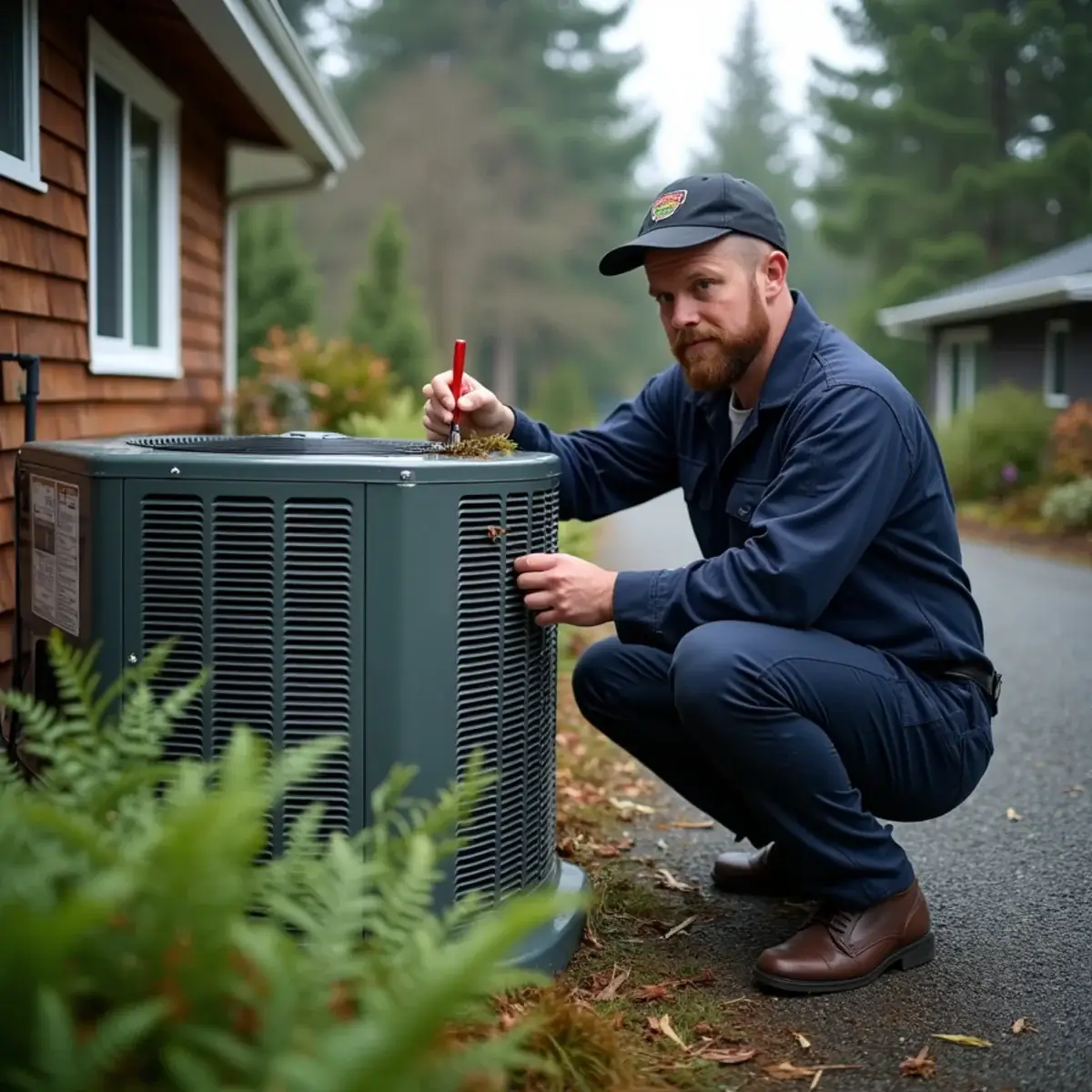
Chico is one of the closest places we work, roughly 10 to 15 minutes from central Bremerton by way of Kitsap Way and SR-3. As an HVAC contractor in Chico, WA, we know the area as a mix of rural acreage, homes tucked along Chico Way NW, and properties that back onto Chico Creek.
It feels far more rural than the short drive suggests. Long gravel driveways, big second-growth firs and houses set well back from the road are normal, and each changes how we plan the work.
Reviewed · travel, permit and utility details are rechecked at each update.
Tree-shaded lots along Chico Creek keep outdoor coils wet and mossy
The trees are the story in Chico. A heat pump sitting under Douglas fir or cedar collects needles, cones and moss in its coil fins all fall and winter. The coil stays damp for weeks at a time, and airflow drops slowly enough that nobody notices.
A clogged coil forces more frequent defrost cycles and longer run times. On a 30°F morning, that shows up as a unit that steams, ices up along the bottom and struggles to keep the house warm. Left alone, it wears on the compressor and the fan motor.
Chico homes range from older cabins and farmhouses to 1970s and 1980s ramblers and newer builds on subdivided acreage. Some still lean on a wood stove or baseboard; many have added a heat pump over the years. Even near the open fairways of Kitsap Golf & Country Club, most houses have a stand of firs close by.
- Needles and moss packed into coil fins and the base pan
- Blocked condensate drains from organic debris
- Shaded, soggy pads that let the outdoor unit settle and tilt
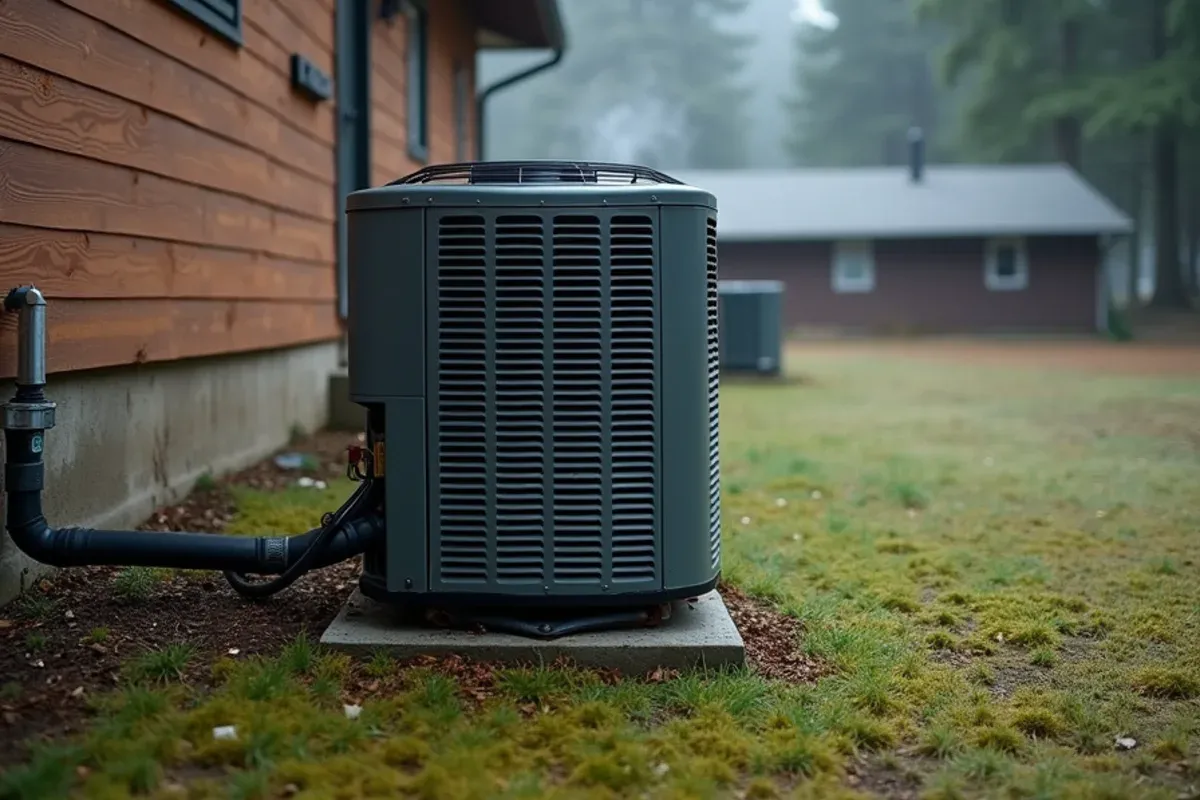
A December call on Chico Way: the heat pump that keeps icing over
A common Chico call comes in December, after a week of rain gives way to a cold, clear night. The owner reports that the outdoor unit is encased in ice, the air from the vents feels lukewarm, and the thermostat is showing emergency or auxiliary heat.
On a typical visit, we shut the unit down, clear the ice safely and find out why it happened. Usually it’s a coil matted with needles and moss plus a base pan that can’t drain. We clean the coil, open the drain path, test the defrost sensor and board, and confirm refrigerant charge.
We also look at placement. Units tucked against the house under a dripline, or set on a pad that has sunk into soft ground, keep coming back. Raising the unit on a stand or moving it a few feet into open air can do more than any replacement part.
Chico Creek draws visitors every fall for its chum salmon run, and many lots sit near it. Near the water, we keep new pads and line sets inside the existing footprint.
Chico at a glance
From our Bremerton base
About 10–15 minutes from central Bremerton via Kitsap Way and SR-3
Neighborhoods & roads we cover
Chico Way NW · Erlands Point Rd · Chico Bay shoreline · Kitsap Golf & Country Club area
Near
Chico Creek · Kitsap Golf & Country Club · Chico Bay · Dyes Inlet
ZIP codes
98312
HVAC services we provide in Chico
Under Chico’s tree canopy, a yearly heat pump tune-up with a proper coil cleaning is the single best way to prevent winter icing.
Frozen outdoor units, failed defrost boards and debris-worn fan motors are the typical Chico repairs. Our heat pump repair visits fix the cause, not just the ice.
Older Chico cabins and ramblers on baseboard or wood heat suit a ductless mini-split, with the outdoor unit placed out from under the dripline.
Falling limbs knock out power around Chico most winters. If your system won’t come back after the lights do, call for no-heat repair.
Why Chico’s wooded properties suit a crew ten minutes away
Tree cover, long driveways and soft ground shape almost every job here. Our habits are built around them.
Coil cleaning timed after the needle drop
Under Chico’s firs, we schedule heat pump maintenance for late fall, once the heaviest needles are down, so the coil starts winter clean instead of half-matted.
Dated photos of what the canopy is doing
We photograph the coil, base pan and pad on each visit. Over a few seasons, those dated images show whether a unit under the dripline is worth relocating.
Parts on the van before the drive
Icing calls near Chico Creek usually trace to defrost sensors, boards, capacitors or fan motors, so we stock those first and avoid a second trip down a gravel lane.
On our regular routes
Chico sits on the way to Seabeck and Silverdale, which makes a follow-up check after the first freeze an easy stop.
Before the new unit arrives: site prep on a Chico acreage
A replacement on a wooded Chico lot is decided as much in the yard as in the equipment catalog. Before install day, we walk the route from the road to the unit location, because a long gravel drive, a narrow gate or a soggy lawn changes how equipment gets there and what the crew brings.
The spot itself gets the most attention. A new outdoor unit should sit clear of the dripline, on a stand or pad that will not sink into saturated ground, with a condensate and defrost-water path that drains away from the foundation. We also look up: a dead limb over the new unit is a future repair call.
- Mark septic lines, drain fields and buried utilities before anyone digs or sets a pad.
- Plan limb trimming by an arborist before install day, not after.
- Confirm where the new electrical disconnect and line set will run, so the path avoids roots and runoff.
- Ask whether the quote includes a raised stand, pad and any extra line set length a better location needs; our heat pump installation quotes list them separately.
FAQ
HVAC questions from Chico homeowners
Why does my heat pump in Chico keep icing up?
Some frost in winter is normal, and the defrost cycle should clear it regularly. A unit that stays encased in ice usually has a coil clogged with needles and moss, a base pan that cannot drain, or a failing defrost sensor or board. Turn it off, switch the thermostat to emergency heat, and have the coil and defrost controls checked.
How often should I clean a heat pump that sits under trees?
For Chico lots with heavy fir and cedar cover, plan on a professional coil cleaning at least once a year, ideally in fall after the needles drop. In between, gently brush leaves and needles off the top grille and keep about two feet of clearance around the unit. Never pressure-wash the coil, because it bends the fins.
Can you move my outdoor unit out from under the trees?
Often, yes. Relocating a heat pump a few feet usually means extending or replacing the line set and condensate path, adding a new pad or wall bracket, and moving the electrical disconnect. It is not a small job, but for a unit that ices up every winter, it can end the repeat repairs.
The power came back after a storm but my heat pump won’t run. What should I check?
First, confirm the breakers for the outdoor and indoor units are on, and that the thermostat has power and is set to heat. Many heat pumps wait several minutes after power returns before restarting. If it still does not run, or you hear buzzing without the fan spinning, shut it off and call for service rather than cycling the breaker repeatedly.
Do I need a permit to relocate or replace a heat pump in Chico?
Usually, yes. Chico is unincorporated, so mechanical permits come from the Kitsap County Department of Community Development, and moving the electrical disconnect or adding a circuit generally needs a separate electrical permit through Washington L&I. A licensed contractor should pull both, schedule the inspections and give you the permit numbers. Simple coil cleaning or part repairs normally do not need one.
My Chico address says Bremerton. Does that affect scheduling service?
Not at all. Most Chico homes use a Bremerton 98312 mailing address, even though Chico is its own unincorporated community. When you call, give the nearest cross street on Chico Way NW or Erlands Point Rd and describe the driveway, gate or turnaround. That helps us bring the right vehicle and find houses set far back from the road on the first try.
Nearby areas we serve
Call your Chico HVAC contractor
HVAC Contractor in Bremerton, WA
Serving Bremerton, WA & Kitsap County